
Criminal Cases in the Graves County Courts
Graves Circuit Court hears felony prosecutions after indictment. Graves District Court handles misdemeanors, violations, traffic matters, and the first steps in felony cases. That first felony file may use an F designation before an indictment produces a Circuit Court CR case. A number such as 24-CR-00180 identifies the filing year, the Circuit Criminal type, and the sequence. The labels matter because a clerk can search faster when the caller knows whether the matter began in District Court or moved to Circuit Court.
One Office of Circuit Court Clerk keeps both courts' official files. The Kentucky Court of Justice Graves County page lists the current court location and clerk contact. The Graves County Clerk is a different office that records deeds, liens, marriages, elections, and other county documents. It is not the criminal-court custodian. For a judgment, docket, indictment, or criminal order, use the Circuit Court Clerk.
Graves County Court Records Moved
The December 2021 tornado damaged downtown Mayfield and court records. Current court operations are at Graves County Courthouse (Temporary), 1102 Paris Road, Suite 21, Mayfield, KY 42066. The clerk is open Monday through Friday, 8 a.m. to 4:30 p.m., and answers 270-247-1733. Older official directories may still point to 100 E. Broadway or name a former clerk. Check the judiciary's current county page before traveling, especially for an archived Graves County criminal case.
The official judiciary source also shows the relocated court access details. Its current courthouse screen appears below.
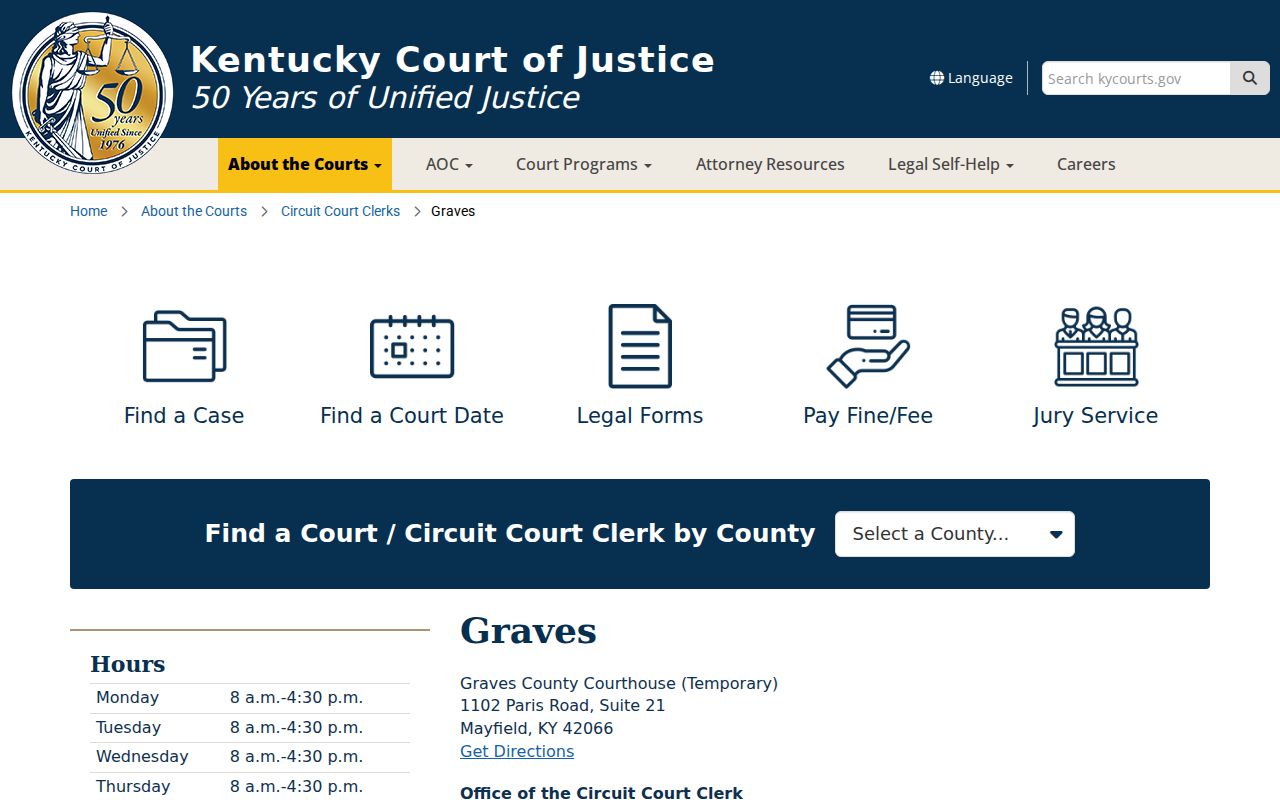
The temporary address is more than a mailing detail. A file may be at the clerk's counter, at a separate records facility, or no longer retained under a judicial schedule. If staff say the case is stored elsewhere, ask for the facility name and the file locator before making another trip.
How to Search Case Records
Ordinary public users do not have a free, open-web CourtNet name search. The local clerk is the main route for the actual Graves County criminal case file. Start with a full name, approximate year, and court type. Add a date of birth when the office lawfully accepts it. A case number is best because name spelling, aliases, and people with similar names can produce weak matches.
- Call the Graves Circuit Court Clerk and state whether the matter is likely District criminal, traffic, felony preliminary, or Circuit Criminal.
- Give the case number when known. Otherwise provide the full name, useful prior spellings, and an approximate filing year.
- Ask whether the file is on site, archived at a records facility, or indexed under linked District and Circuit numbers.
- Inspect the docket first. Identify the entry for the charge, disposition, judgment, sentence, or order that answers the question.
- Request only the needed pages and ask the clerk for current plain-copy and certified-copy costs before ordering.
These are the most useful search inputs for a Graves County court request.
| Field Label | Type | Required | Notes |
|---|---|---|---|
| Last name | Text | Yes for name search | Include former spellings or aliases separately. |
| First and middle name | Text | Yes for name search | Use the name shown when the case was filed. |
| Case number | Text | No, but best | Keep the year, type letters, and sequence together. |
| Date of birth | Date | No | Helps distinguish common names when accepted. |
| Case type and year | Text | No | Examples include M, T, F, and CR. |
The Kentucky court-record request instructions distinguish case records from AOC administrative records.
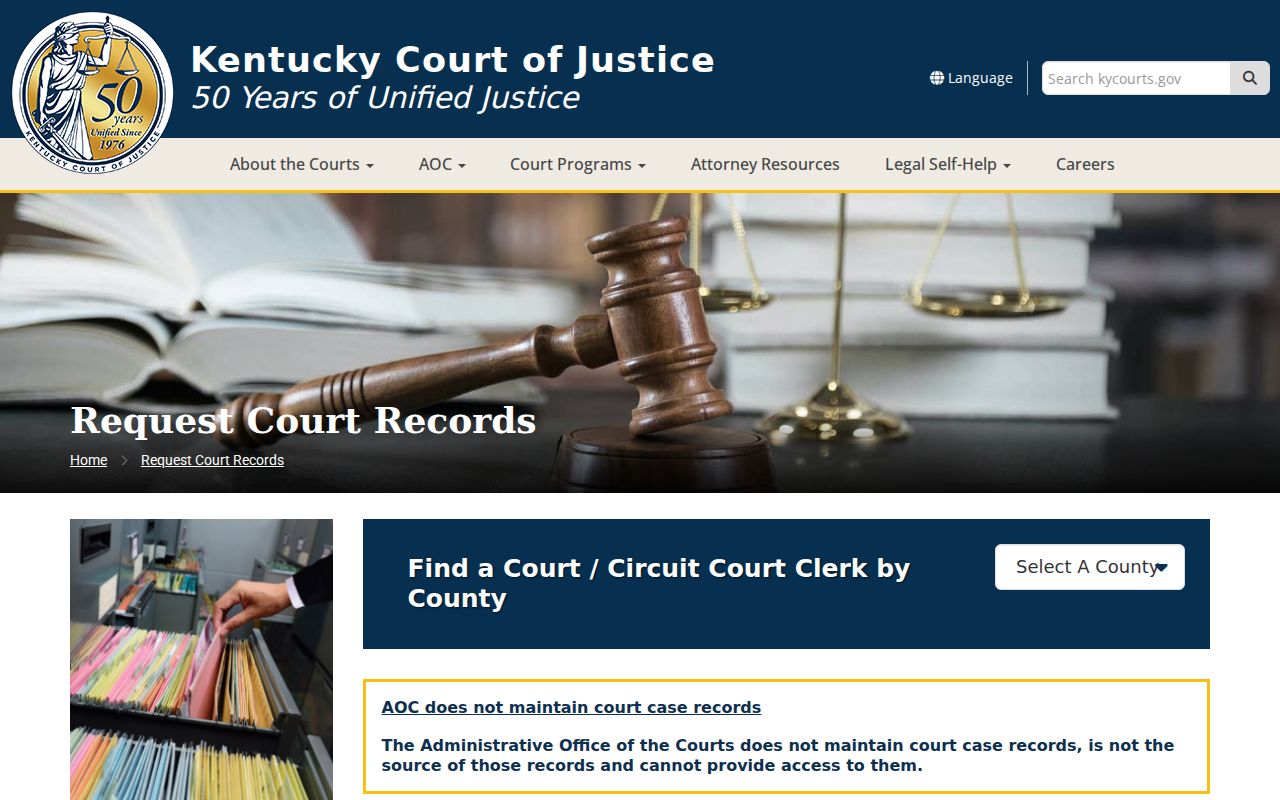
Use the AOC process only for agency records such as reports or statistics. A motion, docket, or judgment belongs with the Graves clerk.
Graves CourtNet Search Limits
CourtNet is the Kentucky Court of Justice statewide case-information database, but general public access is not a free search box. Approved subscribers, including qualifying attorneys and media users, may receive access. The public “Find a Court Date” tool is narrower. It helps with scheduling and does not provide the full Graves County criminal case record, all documents, or a certified disposition.
The official CourtNet access page explains its restricted scope and application route.
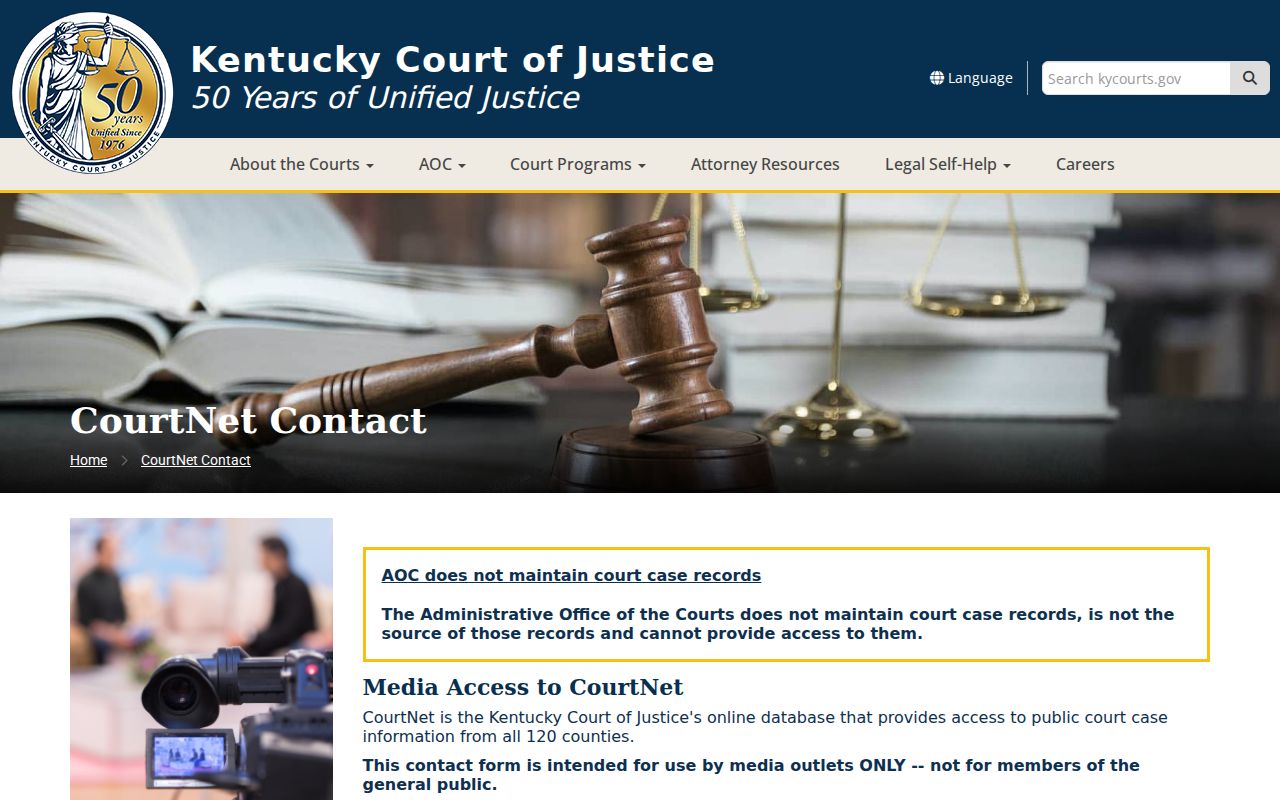
A missing public schedule result is not proof that no case exists. The event may have passed, the file may be archived, the name may differ, or the matter may be confidential or expunged. Call the clerk when the scheduling tool does not resolve the search.
What the Case File Shows
A Graves County criminal file may hold a citation or complaint, an indictment, motions, orders, a docket, the judgment, and sentencing papers. Recordings or transcripts may exist when created and retained. The docket is the best index, but it is not the same as a signed order. Read the original charge, any amendment, and the final disposition as separate fields. That sequence prevents an early allegation from being mistaken for the outcome.
| Case Number & Court | Shows the filing year, case type, sequence, and whether District or Circuit Court owns the file. |
|---|---|
| Charging Document | States the accusation filed through a citation, complaint, or indictment. An indictment is not proof of guilt. |
| Docket Entries | Chronologically index hearings, filings, motions, and orders entered by the clerk. |
| Hearing Dates | Show scheduled and completed court events, subject to later continuances or corrections. |
| Disposition & Judgment | Records whether a charge was convicted, dismissed, acquitted, or otherwise resolved; the signed judgment is controlling. |
| Sentence & Conditions | May state incarceration, probation, diversion, fines, restitution, and other court-ordered terms. |
Note: A docket entry summarizes court activity, while the signed Graves County order supplies the authoritative language for that event.
FastCheck Versus Graves Court Files
AOC FastCheck and One-Time Request produce statewide, court-data-based criminal record reports. They cover Kentucky District and Circuit Court activity across all counties, with traffic and misdemeanor matters for at least five years and felony matters dating to 1978. The products exclude federal, juvenile, mental-health, domestic-violence, and expunged or purged matters. FastCheck users register and retrieve results online. One-Time reports arrive by mail, and orders are not expedited.
The official ordering information is shown in the assigned Graves County court-access image.
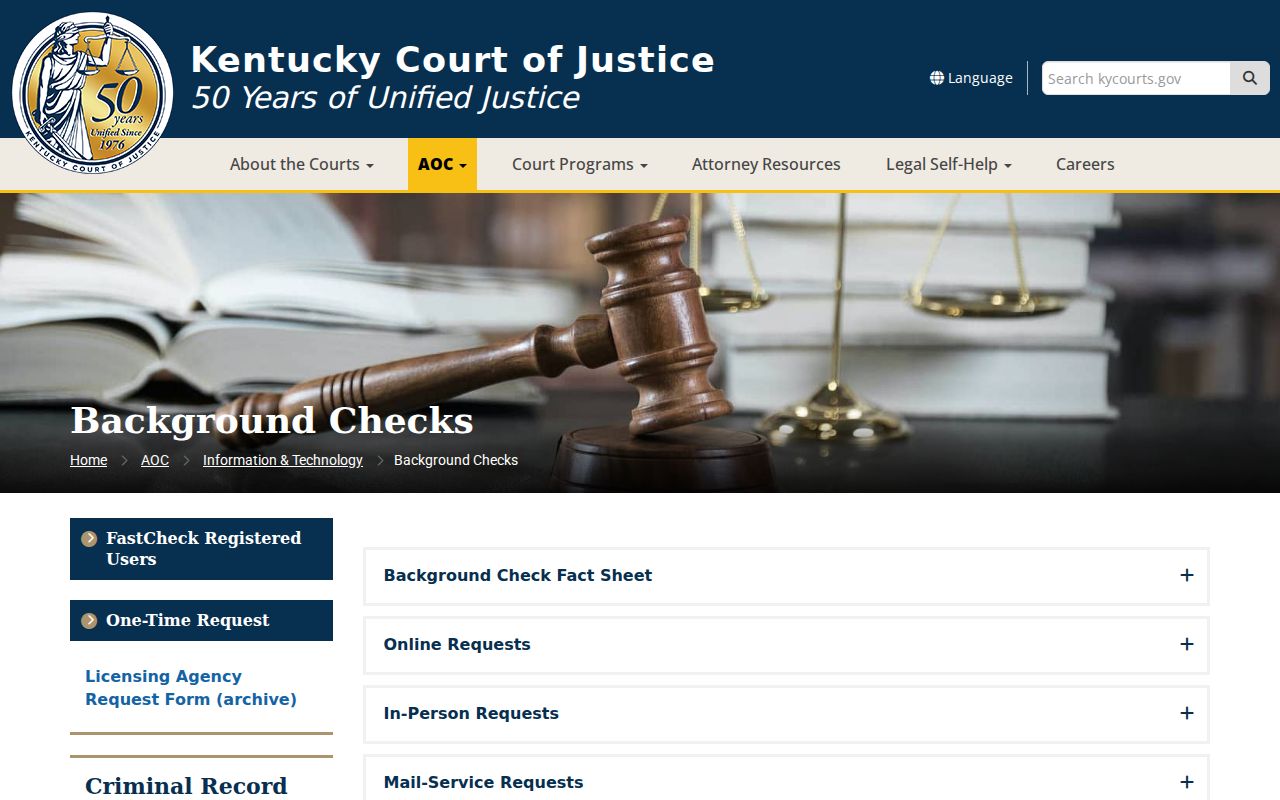
An AOC result can list county, case number, original and amended charges, disposition, key dates, and a clerk memo. It also states “Not an Official Court Record.” For proof, match that summary to the signed judgment or order from the Graves clerk. If AOC data appears wrong, call its Records Unit at 800-928-6381, then contact the local clerk if the source file needs review.
Stages of a Criminal Case
An arrest or citation may start a District Court file. At arraignment, the charge is presented and a plea is entered. A felony can proceed through a preliminary stage and grand-jury review. If indicted, it becomes a Circuit Court CR case. Motions, hearings, a plea, a trial, dismissal, or acquittal shape the docket. A conviction then leads to judgment and sentencing. The research does not support fixed local time estimates, so use the entered dates in the actual docket.
Case flow: Arrest › Booking › Charges › Arraignment › Disposition › Sentencing
The path is not always linear. A charge can be amended, a hearing continued, or a case dismissed before trial. A felony preliminary number and later indictment number may describe related stages rather than two unrelated events. Ask the clerk to confirm linked numbers.
Graves Charges and Court Outcomes
An arrest charge, a filed charge, and a final disposition can differ. Police and jail records preserve the intake allegation. The prosecutor may decline, amend, or replace it. A grand jury may indict on a different count or return no true bill. The court file then records the actual outcome, which may be conviction, acquittal, dismissal, diversion, or another entered result. Compare dates as well as wording because the charge date and disposition date answer different questions.
Several terms recur in Graves County criminal cases. A disposition is the result of a charge. Nolle prosequi means the prosecutor formally chose not to continue it. An acquittal is a not-guilty finding. A dismissal ends the charge without a conviction. Pretrial diversion pauses prosecution while the person completes set terms. None of those labels should be reduced to the original booking allegation.
Expunged Graves County Case Records
Kentucky restricts juvenile matters and several confidential case types. An expungement goes further by removing eligible record information under court order. Most adult cases dismissed with prejudice or ending in acquittal on or after July 15, 2020 are automatically expunged after 30 days, except traffic cases. Other misdemeanor, violation, or eligible felony matters follow the process in KRS Chapter 431.
The Kentucky Court of Justice expungement resource explains certification, automatic relief, felony steps, forms, fees, and effects.
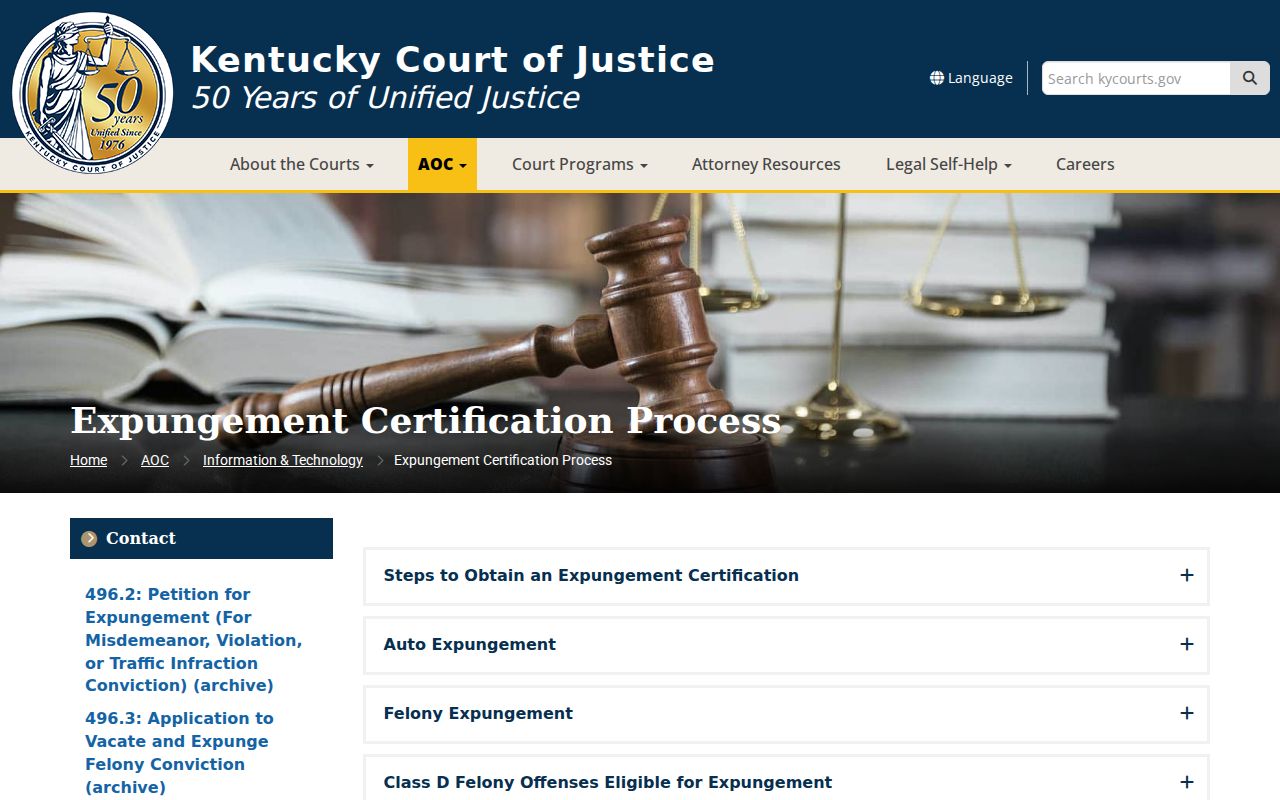
A lawful absence after expungement is not a search failure. If reviewing one's own case, retain a copy of the expungement order and ask the Graves clerk which agencies received it. An old private copy or news item does not override the official court status.
Access & Restrictions
Court access runs through judicial clerk procedures, while sheriff and police records fall under the Kentucky Open Records Act. That difference controls where a request goes. Public court files may still contain redactions, and juvenile, protected personal, victim, mental-health, domestic-violence, sealed, or expunged material may be restricted. Grand-jury deliberations are secret even though a filed indictment can appear in a public court file.
If a Graves County criminal court case does not appear, give the clerk the name, likely year, and any related case number. Ask whether the file is confidential, expunged, archived, linked to another number, or destroyed under the applicable retention schedule. Do not assume that a blank search proves no history. For a sheriff arrest or incident report tied to the court case, follow the agency's written request process rather than asking the clerk for a police narrative.
Note: Request the final entered order when the disposition matters; a charge list or calendar entry can be incomplete or outdated.